By David
Is a p0.9 led display worth it? For most control-room and high-end integration projects, yes — but only when the viewer sits close and the budget covers the real cost of sub-1mm pitch. A p0.9 led display is a manufacturing achievement, not a default choice; where the audience stands back, a P1.2 panel often delivers the same result for less. This 2026 guide explains the sub-1mm mass-production reality: yield, cost, maintenance, and where P0.9 genuinely belongs.
A sub-1mm pixel pitch is where LED display manufacturing stops being routine. Below roughly one millimetre, the spacing between LEDs is smaller than the eye can resolve from a normal conversation distance, and every part of the build — the LED chip, the driver IC, the PCB, the bonding, the cabinet — has to be made to a tighter tolerance. That precision is what separates a p0.9 led display from an ordinary fine-pitch panel.
This guide is written for high-end integrators and control-room project owners who are weighing the sub-1mm class. It looks at P0.9, P0.7, and P0.6 through the lens of mass production — what can be built at scale and repeatably, what it costs to own, how it is maintained, and where a coarser pitch is the smarter engineering decision.
Pixel pitch is the centre-to-centre distance between two adjacent LED clusters, measured in millimetres. At P0.9, that distance is 0.9 mm, which is under one millimetre. A p0.9 led wall therefore packs a very high number of pixels into every square metre, and that density is what lets the image look smooth and continuous when it is viewed from only a short distance.
The sub-1mm class covers pitches such as P0.9, P0.7, and P0.6, at the fine end of the fine-pitch and micro pitch market. These panels are chosen where the viewer stands close — control rooms, command centres, boardrooms, broadcast studios, and premium lobbies — and where a visible pixel grid would break the sense of a continuous image.
A useful rule of thumb in the industry is that comfortable viewing distance is around ten times the pixel pitch. On that basis, P0.9 suits viewers within roughly a few metres, P1.2 is comfortable a little further back, and P0.6 is for the closest viewing of all. The exact figure depends on the content, the room, and the eye, so treat the rule as a starting point for the discussion rather than a hard limit.
| Pitch | Typical Role | Viewing Character |
|---|---|---|
| P1.2 | Control rooms, larger meeting spaces | Comfortable from a few metres back |
| P0.9 | Close-view control rooms, studios | Smooth at close range |
| P0.7 | Premium close-view, high-end studio | Smooth very close |
| P0.6 | Specialist close-view and showcase | For the closest viewing |
The hard part of sub-1mm is not the concept; it is doing it repeatably, thousands of times, at a failure rate low enough to be commercially viable. As pitch shrinks, the LED chip gets smaller, the placement tolerance tightens, and the bonding becomes more delicate. A defect that would be invisible at P2.5 becomes a dead pixel that a close viewer spots immediately on a p0.9 led display.
This is why yield, and not the datasheet pitch, is the real manufacturing question. Almost any capable supplier can build a single P0.9 sample; holding that quality across a full production run of a large wall is a different problem. Buyers should ask how a supplier controls consistency across modules, how it screens panels before shipping, and how it handles the units that fail — not only what the best sample looks like.
Mass production of sub-1mm also depends on the packaging technology. COB, or chip-on-board, bonds the LED chips directly onto the board and seals them, which protects the delicate chips and improves mechanical robustness — an advantage when the pitch is small and the viewer is close. SMD and GOB remain important options at coarser pitches, and a supplier that masters all three can recommend the right one for a project rather than pushing a single technology.
For years, sub-1mm pitches were fragile. The LEDs sat exposed on the surface, and a brushed hand or a cleaning cloth could damage them. COB changed that by encapsulating the chips, so the surface is more resistant to touch, dust, and moisture. For a close-view panel where the screen is often within reach, that robustness matters as much as the image quality.
The trade-off is that COB is a more demanding process, and not every factory can run it at sub-1mm. The technology rewards scale: a manufacturer with many dedicated COB lines can keep quality consistent and cost under control, while a small workshop may only manage samples. When a buyer evaluates a p0.9 led display, the depth of the COB production line is more telling than a brochure specification.
At Asia Vision, sub-1mm work runs on dedicated COB capacity. The COB P0.93 product is already in mass production, which means the pitch rests on a repeatable process rather than a one-off prototype. A product range like the COB CV Pro series is built for close-view control and command environments, and the same lines also serve the wider fine-pitch range.
Sub-1mm displays are the most expensive LED panels per square metre, and the reason is not marketing. The smaller LED chips, the tighter placement tolerance, the more delicate bonding, and the lower yield per production run all raise the real cost of manufacture. A p0.9 led wall also needs more driver ICs and a more complex PCB than a coarser panel of the same size, because there are far more pixels to drive.
The purchase price is only the start. The total cost of ownership adds the processor and control system, the installation, the power and cooling, the spare modules, and the maintenance over the display's life. In a control room that runs continuously, a finer pitch can raise power draw and heat, which then affects the room's cooling. Buyers should compare the whole package, not the panel price alone — a cheaper P1.2 system that fits the room may cost less to run for years.
For these reasons, the sensible question is not what is the lowest pitch I can buy, but what is the lowest pitch this project actually needs. That framing protects the budget and keeps the specification honest.
A close-view display is watched closely, so even a single dead pixel can be noticed. That raises the bar for maintenance. Modules, driver ICs, and power supplies can all fail, and on a sub-1mm panel the replacement parts are more specialised and often more expensive than their equivalents on a coarser screen.
Front service access is a practical necessity. In a control room, the wall usually sits against a wall or in a recess, so rear access is impossible. A front-service cabinet lets a technician replace a module from the room side without dismantling the installation. Buyers should confirm the service method before the order, because a wall that cannot be serviced in place is a wall that stays faulted for longer.
Spare parts planning follows from the same logic. Holding a few spare modules of the correct pitch and batch on site shortens downtime. A manufacturer that supports the project after delivery — with spares, firmware, and technical guidance — makes a sub-1mm wall sustainable rather than a liability.
The choice between P0.9 and P1.2 is the decision most close-view projects actually face, and it comes down to viewing distance and content. If the closest viewer sits within a couple of metres and needs a seamless image — a control desk, a studio backdrop, a prestige lobby — then P0.9 earns its cost. If the front row sits further back, or if the content is data and schematics rather than close-read imagery, P1.2 often looks indistinguishable at the seat.
It is worth testing the two side by side if possible. A supplier can usually arrange a comparison, and the result is more convincing than any specification. Our fine-pitch selection guide walks through the same logic in more detail and is a useful companion when the pitch decision is close.
| Project Situation | Pitch That Fits |
|---|---|
| Front-row viewers at only a few metres | P0.9 |
| Continuous data and schematics, viewers a bit further back | P1.2 |
| Frequent close-up imagery, prestige lobby | P0.9 |
| Standard meeting room with a normal seating distance | P1.2 |
| Broadcast studio backdrop with very close framing | P0.9 or P0.7 |
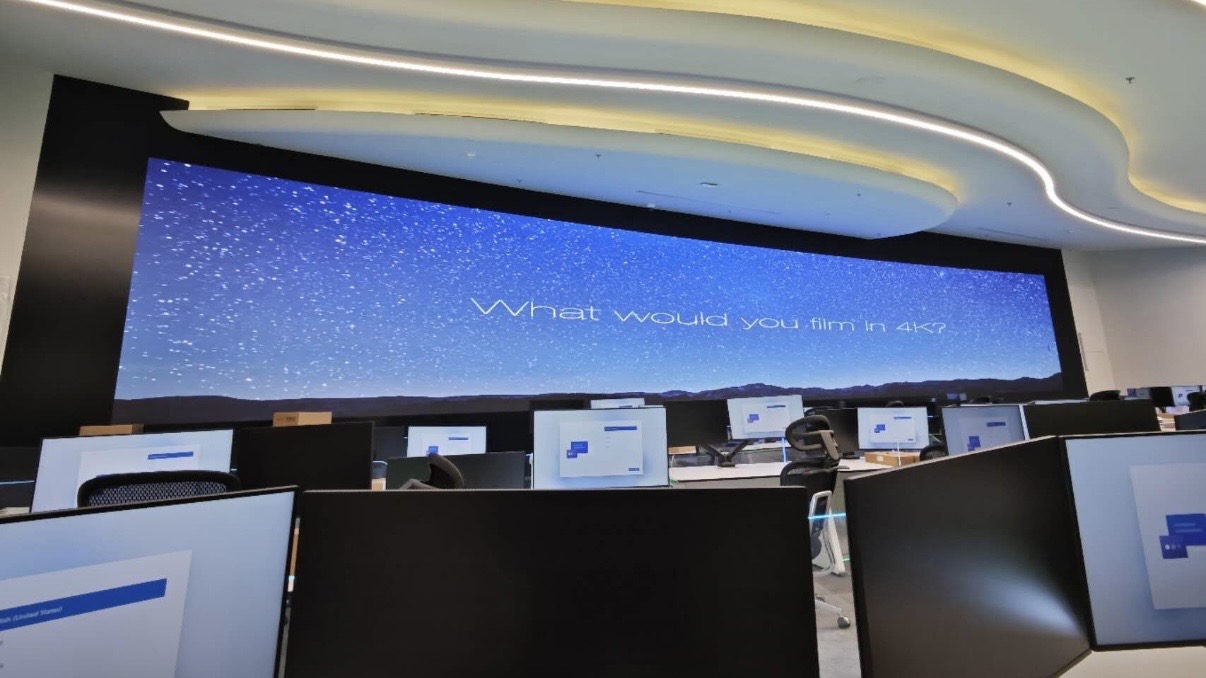
P0.9 makes sense when the viewing distance is short and the content demands it. The classic cases are control rooms and command centres, where operators sit close and watch live data, maps, and video for long shifts. The pitch lets them read fine detail without the pixel grid intruding, and a smooth image reduces eye strain over a full day.
Studios and broadcast sets are another strong fit, because a camera can pick up the pixel structure of a coarser screen, while a sub-1mm panel holds up under close framing. Premium lobbies and executive spaces also justify P0.9 when the display is part of the brand experience and sits within a few metres of visitors.
In all of these, the justification is the same: the viewer is close, the content is detailed, and the seamless image is worth the premium. Where any of those three is missing, the case for P0.9 weakens.
For many projects that assume they need sub-1mm, P1.2 is the better engineering choice. If the front row sits several metres back, the eye resolves less than the specification suggests, and the extra pixels of a p0.9 led display deliver little visible benefit while adding cost, power, and heat. Meeting rooms, auditoriums, and retail feature walls often fall into this category.
P1.2 panels are also more forgiving on cost and maintenance. The parts are less specialised, the yield is higher, and the running costs are lower, which lowers the total cost of ownership across the display's life. Choosing P1.2 where it fits is not a compromise; it is good engineering, and it leaves budget for the processor, the content, and the spares that a project genuinely needs.
A sub-1mm specification should start from the viewing distance and the content, not from the pitch. State the closest viewing position, the typical content, the ambient light, and the required image quality. From there the pitch follows, and P0.9 becomes a reasoned choice rather than an assumption.
The specification should also cover the packaging technology, the brightness, the refresh rate for camera work, the cabinet depth, the service method, the control system, and the spare parts. For a control room, the refresh rate and the processing matter as much as the pitch, because a low refresh rate can cause flicker on camera or in photographs. Buyers should specify these together, since they decide whether the installation works in the room rather than on paper.
The most common mistake is buying a lower pitch than the project needs: the viewer never gets close enough to benefit, and the budget goes into pixels that no one can see. The second is the opposite — underestimating the room and fitting a pitch that shows its grid from the front seat. Both come from skipping the viewing-distance exercise.
Other frequent errors are forgetting front-service access, ignoring the power and cooling load, and buying from a supplier that can only produce samples rather than consistent production runs. A sub-1mm wall that cannot be serviced, or that cannot be matched with spare modules, becomes a problem long after commissioning is complete. Each of these mistakes is avoidable with a short, disciplined specification phase.
Sub-1mm displays reward a supplier with real production depth. Shenzhen Asia Vision Technology builds indoor and outdoor LED displays, COB panels, rental systems, fine-pitch and custom cabinets, and supports SMD, GOB, and COB packaging. Its sub-1mm work runs on dedicated COB lines, and the COB P0.93 product is already in mass production — the point at which a pitch moves from a demo to a dependable product.
Production depth also covers the parts of a project that buyers only notice when they are missing: cabinet customisation, ageing tests before shipping, quality control, and export delivery. Reviewing a factory process is a better measure of sub-1mm capability than any single specification sheet, because it shows whether the pitch can be built again next month and the month after.
After delivery, support keeps a close-view wall running. Asia Vision provides a two-year warranty and 24-hour support, and ships to key markets across the Middle East, Europe, North America, Latin America, and Southeast Asia. For a control room or studio that cannot afford long downtime, that ongoing support is part of the value, not an extra.
A p0.9 led display is a strong choice when the viewer is close, the content is detailed, and the seamless image is worth the premium. It is the wrong choice when the audience sits back, the budget is tight, or the project simply assumes that a smaller pitch is always better. The manufacturing reality — tighter tolerances, lower yield, higher cost, more demanding maintenance — is what makes that distinction matter.
The practical path is to start from the room and the viewer, choose the pitch that the viewing distance justifies, and confirm that the supplier can mass-produce it, service it in place, and support it for years. When P0.9 clears those tests, it delivers an image that no coarser panel can match at close range. When it does not, P1.2 is not a step down — it is the right answer.
Tell us your viewing distance and content, and we will help you decide whether P0.9, P0.7, or P1.2 is the right pitch for your project.
Request Sub-1mm AdviceChat on WhatsApp