By Cassie
A display is only as good as the modules inside it, and yet module selection is often treated as a formality once the pixel pitch has been chosen. In practice the module package, the driver arrangement and the brightness binning decide how the screen looks on camera, how it behaves when a customer stands six feet away, and whether a replacement part ordered three years later still matches the wall it has to blend into.
Module choice also interacts with everything downstream. A sealed package suits a humid or public environment but constrains the servicing approach; a finer pitch raises the data and power demand per cabinet; a different brightness bin shows up as a visible patch on an otherwise uniform wall. This guide covers what to weigh when selecting modules, the practices that keep a wall consistent over its life, and the specification and support questions that come up in procurement.
The first consideration is the module package and what it means for the environment the screen will live in. A conventional surface-mount package exposes individual emitters and offers strong optical performance with straightforward servicing, but it is the most vulnerable to physical knocks and to moisture if the cabinet is not adequately protected. A chip-on-board package seals the emitter array behind a continuous surface, which raises contrast, resists accidental contact and simplifies cleaning, at a higher cost per unit area that is justified by fine pitch and close viewing. A glue-on-board package sits between the two, adding a protective layer over a surface-mount array for installations where impact resistance is the priority.
The second consideration is pitch against viewing distance, and here the discipline is to resist overspecifying. Resolution beyond what an audience can perceive is capital that never returns, so pitch should be chosen from the shortest realistic viewing distance rather than from the finest pitch the budget allows. The relationship is straightforward: the closer the closest viewer, the finer the pitch needs to be. A wall read from ten metres is well served by a pitch that would look coarse to someone standing two metres away, and the same money spent on pitch instead of on brightness or redundancy often buys a better outcome.
The third consideration is consistency, because a video wall is judged as a single surface rather than as a collection of cabinets. Modules from different production runs can differ slightly in brightness and colour, and a wall assembled from mixed bins shows seams that are invisible in isolation but obvious once the screen is running a pale, uniform image. Selecting a package with controlled binning and ordering the whole wall from one batch is the practical defence, and the same discipline has to be applied to any replacement parts ordered later in the screen's life.
The fourth consideration is serviceability and the spare parts plan. A module is the most commonly replaced component in a display, so the selection decision should include how a module is removed, whether that can be done from the front, and whether the same part will still be available in three or five years. The table below sets out the selection variables that should be settled before an order is placed.
| Variable | Why It Decides the Outcome | Practical Approach |
|---|---|---|
| Module package | Governs durability, contrast and servicing | COB for fine pitch and public contact, SMD for general use |
| Pixel pitch | Must match the closest viewing distance | Choose the coarsest pitch the audience cannot fault |
| Brightness binning | Controls visible seams across a wall | Order one production batch for the whole wall |
| Driver arrangement | Affects refresh, low-brightness behaviour | Match driver to the required refresh rate |
| Service access | Determines maintenance cost over life | Front-service modules for flush-mounted walls |
| Spare compatibility | Decides whether future repairs match | Confirm long-term part availability with the supplier |
Order the whole wall from a single production batch. Binning exists because LED emitters vary slightly, and the variation is invisible in a single cabinet but visible across a large wall running a uniform test pattern. Placing the entire screen as one order, rather than adding cabinets later from a different run, is the most effective way to guarantee uniformity. Where an expansion is planned, it is worth telling the supplier at the original order so that the batch size accounts for the future requirement and the binning is consistent between the two deliveries.
Verify the module in the environment it will run in. Brightness and contrast read very differently in a showroom than in a glazed lobby or an outdoor canopy, and a demonstration in the wrong conditions produces a selection that disappoints on site. Where possible, review the module running content that resembles the final use case rather than a saturated demo reel, because pale, uniform content is where uneven binning and low contrast become obvious, while a colourful promotional clip conceals exactly the faults a buyer should be looking for.
Plan the spare parts allocation at the same time as the order. A small reserve of modules held centrally or on site converts a failure from an outage into a routine repair, and because production is quoted at 15 to 20 working days, a screen with no spares can be dark for a meaningful period while a replacement is made. The reserve should be sized to the cabinet count and the maintenance round, and it should come from the same batch as the wall so that any panel fitted later matches the rest of the screen.
Document the module specification and keep it with the installation. Three years after commissioning, the person who chose the module may have moved on, and a replacement decision made without the original specification risks a mismatch in brightness bin, driver behaviour or connector type. An asset record listing the module part number, the pitch, the batch reference and the supplier contact is a small administrative step that protects a substantial capital asset.
Module selection is ultimately a question of whether the same part will still exist when a wall needs one. Asia Vision Technology builds around fixed module and cabinet formats, so a specification chosen for a project remains orderable years later and a spare fitted in year four matches the wall it joins. That repeatability applies across the portfolio: pixel pitch spans P0.9 to P20, so a fine-pitch COB installation and a coarse-pitch outdoor facade can be sourced from one supplier with one spare parts discipline rather than several incompatible inventories.
Binning control is where module quality is actually decided. Asia Vision assembles a wall from a single production batch so that brightness and colour remain consistent across the whole screen, and it does so for the COB indoor range at 10000:1 contrast as well as for the CV-PRO and D-PRO families. Indoor brightness is selectable from 800 to 2500 nits and outdoor cabinets run from 5000 to 10000 nits, with refresh at 3840 Hz or above indoors and 1920 Hz or above outdoors, so the module can be matched to the environment instead of the environment being adapted to the module.
Every panel carries a rated 100,000 hour service life and a three-year warranty, and products hold CE, FCC and RoHS certification with UL and ETL paths for North America and UKCA documentation for the United Kingdom. Production is quoted at 15 to 20 working days, which is short enough that a batch-consistent spare or a phased expansion does not have to be ordered a season ahead.
Reading the module specification alongside the cabinet specification is what prevents a mismatch. A fine-pitch module raises the pixel count per cabinet, which increases the data demand and can shorten the supported signal chain, while a high-brightness outdoor module raises the current draw and therefore the power provision. The table below sets out the module-level specification envelope for the main product families so that the module decision and the cabinet decision can be made together rather than in sequence.
Two module characteristics deserve particular attention during specification. The first is the driver arrangement, which determines refresh behaviour and how the panel performs at low brightness, both of which matter on camera and in dim conditions. The second is the module's mechanical interface, since a module that does not share the mounting and connector geometry of the rest of the range cannot be rotated between installations or used as a spare elsewhere in a portfolio.
| Product Family | Module Package | Pitch Range | Key Specs | Best Suited To |
|---|---|---|---|---|
| CV-PRO Indoor | SMD and COB options | P1.2 to P2.6 | 3840 Hz and above, 800-2500 nits | Corporate, retail and control room walls |
| COB Indoor | Chip on board sealed face | P0.9 to P1.5 | 10000:1 contrast, close viewing | Boardrooms, studios, fine-pitch feature walls |
| D-PRO Outdoor | Sealed outdoor module | P3.9 to P6.67 | IP65, 5000-10000 nits | Facades, billboards, canopy signage |
| X Series Rental | Rental module in 500 x 500 mm cabinet | P2.6 / P3.9 | 6.5 kg cabinet, 3840 Hz | Touring, events and temporary builds |
| Large format outdoor | Sealed module, coarse pitch | P6.67 to P20 | IP65, long-distance legibility | Stadium, landmark and building scale |
Modules ship inside the cabinets they belong to, which means the module specification and the mechanical interface arrive already matched to the screen rather than as separate parts to be assembled on site. For projects that include a spare parts allocation, the reserve modules are packed with the same shipment and identified on the packing list so that the on-site pool is established at commissioning rather than ordered reactively. Keeping the spares from the original production batch at the same time as the wall is the reason to include them in the initial order rather than adding them later.
Packing is designed around module fragility as well as cabinet weight. A fine-pitch module has a delicate surface and a coarse-pitch cabinet is heavy for its volume, so the two require different handling and the crate design reflects that. Panels are packed with the accessories belonging to the series, and the shipment documentation includes the conformity certificates needed for customs and for the local electrical inspection where the destination requires one.
Destination voltage and frequency are configured at the factory and labelled on the cabinet. Markets operating a mandatory certification scheme are routed through the appropriate approval process during production so that the consignment is not held at port. Freight is planned by crated volume and weight, with sea, air and rail options matched to the delivery window the site can accept, and phased projects split so that each phase arrives complete with its modules and accessories. Production is quoted at 15 to 20 working days.
The comparison that matters is not the module price but the cost of keeping the wall uniform over its service life. A cheaper module that cannot be bin-matched later will produce a visibly patched screen within a few years, at which point the saving is repaid several times over in either premature replacement or visible quality loss. The relevant questions are whether the supplier controls binning at the batch level, whether the module format is stable enough to remain orderable, and whether the warranty covers the module alongside the driver and supply. The table below lists the comparison points worth putting to a supplier.
It is also worth comparing how each supplier handles a partial failure. Where a module can be replaced independently and from the front, a fault costs one part and a short visit; where the module is integrated into a sealed assembly, the scope of the repair is larger. That difference is invisible in a price list and decisive in a five-year cost of ownership calculation.
| Comparison Point | What to Ask | Why It Matters |
|---|---|---|
| Binning control | Is the wall assembled from one production batch | Determines whether seams appear on pale content |
| Format stability | Is the module orderable in three to five years | Decides whether future repairs match the wall |
| Spare supply | Can a bin-matched spare be provided | Avoids a visible patch after a single replacement |
| Module service | Independent front-service module | Limits repair scope and downtime |
| Package options | SMD, COB or protective layer | Matches durability to the installation environment |
Module faults are the most common hardware issue a display develops, so support is largely about making a replacement quick and correct. Asia Vision Technology provides part numbers, batch references and fitting guidance for the modules in a wall, and because the module format is fixed across the range, a replacement can be specified from the original order record rather than by measuring a failed part. Front-service mounting means the work is normally done from the accessible side of the screen without disturbing neighbouring cabinets.
Panels carry a three-year warranty and a rated 100,000 hour service life, and the warranty covers the module alongside the driver and power supply rather than isolating the emitter array as a wear item. For installations where continuity matters, a small on-site pool of modules from the original batch converts a failure into a routine visit, and Asia Vision can supply matching spare modules against the original specification after the warranty period, with production quoted at 15 to 20 working days.
Where a wall has been expanded since commissioning, it is worth recording the batch reference of every delivery so that a future replacement can be matched to the section it serves. The administrative overhead is negligible and it protects the two things a long-life display depends on: uniformity across the screen and availability of a part that actually fits.
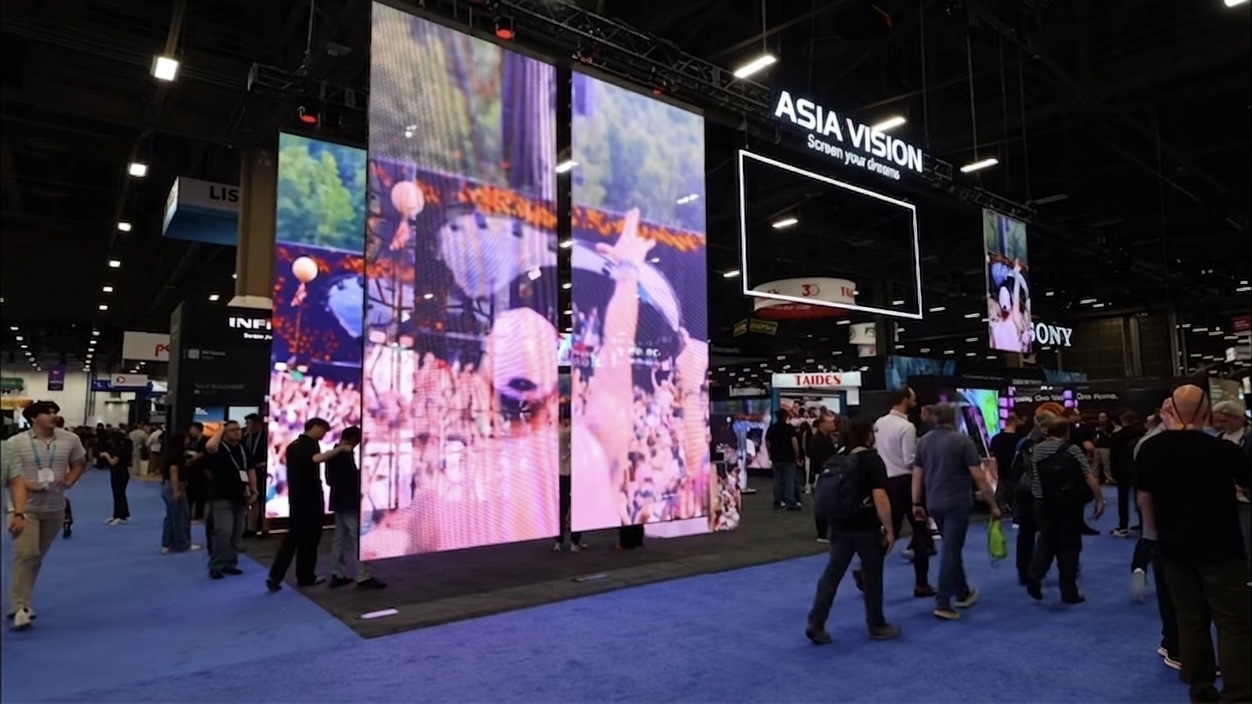
For this requirement our range covers it directly: the RH-PRO fine-pitch COB (flagship, full redundancy) and the COB CV-PRO series (Ultra-HD fine pitch).