By David
Once a display is attached to a building it stops being equipment and becomes part of the structure. That single change brings the display into the world of loads, movement and service access — and it means the screen cannot be engineered by the screen supplier alone.
This guide covers what a facade integration asks of the building, and where the display manufacturer's responsibility ends.
On an exterior face, wind acts on the whole screen area rather than only on the frame, and its effect grows with height and exposure. For a large facade display it is commonly the load that sizes the attachment.
The magnitude is not a manufacturer's figure — it is calculated by the project's structural engineer against the code that applies to the site, using the local wind speed, the building height and the terrain. The manufacturer's contribution is the screen's geometry, its drag characteristics as a surface, and the position of its mounting points, which the engineer needs to run the calculation.
A facade display is normally carried by a secondary steel frame rather than fixed directly to the cladding.
The frame spans between the screen's mounting points and the building's structure, so the load path runs into the primary frame instead of into the facade panels. On a designed curtain wall this interface has to be coordinated with the facade consultant, because the display changes both the loads and the appearance at that plane.
The result is a three-way conversation between the display manufacturer, the facade engineer and the structural engineer, and it works best when the display's interface data is available before the frame is designed rather than after.
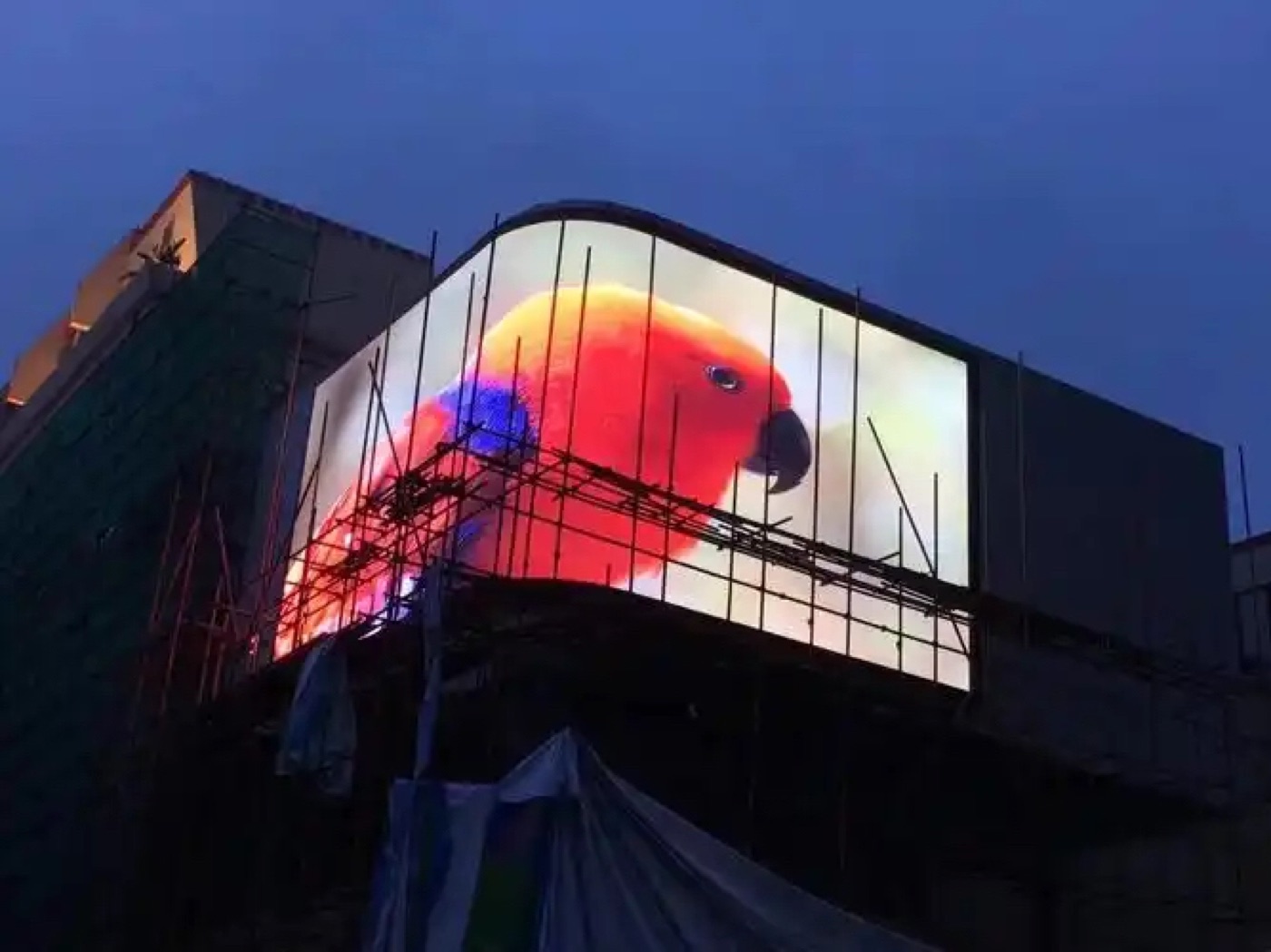
An exterior display sees daily and seasonal temperature swings, and the materials in the screen and the frame move at different rates.
The attachment therefore has to accommodate movement rather than lock the screen rigidly, so that thermal expansion does not load the modules or the frame. On a dark facade the screen also runs warmer than the cladding around it, which affects the cooling path and the temperature of the adjacent materials.
An exterior screen is a surface that rain will run over and wind will drive against, and the detailing has to direct water away from the sealed areas rather than into them.
The screen also has to breathe. Cabinets that are sealed against water still reject heat, and the ventilation path — whether passive or fan-assisted — needs to be designed so that the rejection does not pull water in with the air. This is a detail to settle at design stage, not to adjust on site.
On a facade, the maintenance method is a structural and architectural decision as much as an operational one.
Front-accessible modules allow a panel to be changed from the face of the screen, which avoids bringing a machine to the wall. Catwalks and internal walkways give permanent access at the cost of structure and space. Building maintenance units and rope access serve the screen without internal provisions, at the cost of cost and weather dependence.
Whichever route is taken, it should be settled with the design, because it affects the frame, the building section and the future operating cost of the installation.
The manufacturer's job on a landmark project is to be a reliable technical partner to the design team: to supply interface data early, to answer the engineer's questions on the screen's behaviour, and to hold the interface dimensions that the frame is designed around.
Our factory runs 8 IC production lines and 7 LED SMT production lines under ISO 9001:2015, with CE, FCC and RoHS certification, a 15 to 20 working day lead time and a three-year warranty. For facade installations the usual match is the D-PRO outdoor series, or the COB ZH series where a sealed face and high wind resistance are both required. We issue dimensioned drawings, weight and mounting data, and the attachment interface for the frame design.
For the approvals context, see facade LED permits and sign codes and facade LED procurement.
Send your specifications for a detailed LED display price quote with UL/ETL certification.
Request Price Quote Chat on WhatsApp