By Cassie
A theater stage has always been a place where scenery does work that dialogue cannot, and LED has changed what that work costs. A digital backdrop can become a forest, a city street or an abstract field in the time it takes to black out, and the change happens between two cues rather than between two truckloads of flats. Venues that have moved to LED scenery describe the same two benefits: scene changes stop being a logistical event, and the scenery stops being a fixed asset that only suits one production.
Performance venues also have constraints that studios and corporate spaces do not. Sights lines are tight, wing space is limited, floors get loaded with dancers, and the audience sits close enough to hear a cooling fan. This guide covers what drives demand for LED in theaters and concert venues, the specifications that hold up on a stage, and the questions production managers and venue operators ask during specification.
The clearest driver is the cost of building scenery. A traditional set has to be constructed, painted, stored, transported between venues, and then rebuilt at the next stop on a tour. A digital backdrop replaces the flats, the scenic artist and much of the truck space with a surface that renders any environment the design calls for. For producers, the arithmetic is straightforward: a set that can be reused across productions, rather than built for one run and struck, recovers its cost over a small number of shows and then keeps earning.
Scene change time is the second driver and often the one that changes a director's mind. A physical scene change costs rehearsal hours, crew calls and stage time, and it constrains how the show is written. A digital change takes place between cues, which lets a production move through many more locations than a traditional set would allow. Touring companies value this most, because it removes the requirement for a full local crew to be hired and rehearsed at each venue on a tour.
Venues are also using LED outside the auditorium, and it is frequently the part of the investment that the box office notices first. A lobby wall running show information, cast changes and ticket promotions replaces printed posters and gives the marketing team a channel that can be updated the same day. For a receiving house with several companies passing through, that flexibility is worth as much as the stage display itself.
The final driver is technical. Refresh rates have risen to the point where a display can be on camera without banding, which matters in a venue that films or streams its productions. Contrast and black level have improved enough that a dark scenic field reads as dark rather than as a glowing grey rectangle, which is the difference between scenery that supports a lighting design and scenery that fights it.
Pixel pitch on a stage is set by the closest audience seat plus one step of caution. A backdrop viewed from a front row a few metres away needs a fine pitch, while a rear-stage cyclorama seen from twenty or thirty metres can use something coarser and larger. Getting this wrong in the conservative direction wastes budget; getting it wrong in the optimistic direction produces visible pixel structure in the most expensive seats.
The stage floor is a separate specification entirely, because it has to carry people. Load rating, surface grip and moisture protection matter more than resolution, and the floor also has to be assembled from manageable panels by a touring crew. Noise is the third axis: a fan audible in a quiet dramatic moment is a defect, so venues that stage spoken word as well as music should specify passive or near-silent cooling.
| Application | Series | Cabinet Size | Key Specs | Best Use |
|---|---|---|---|---|
| Stage Backdrop | CV-PRO P2.6 / P3.9 | Custom build | High refresh, deep black level | Scenic backgrounds, touring sets |
| Cyclorama Wall | CV-PRO COB P2.6 | 600 x 337.5 mm | COB sealed face, 3840 Hz | Wash and sky effects, wide coverage |
| Lobby Signage | I-BOARD P1.95 | 750 x 250 / 500 mm | 34.5 mm thin, magnetic front service | Show information, ticketing, events |
| LED Dance Floor | COB Dance P1.98 | 500 x 500 mm | 2000 kg/sqm load, IP65, anti-slip | Interactive stage floors, runway |
| Box Office Ticker | I-BOARD P1.95 | 750 x 250 mm | Low brightness, silent operation | Queue information and pricing |
For scenic backdrops the CV-PRO COB range is the right starting point, and the P2.6 pitch suits most mid-size houses where the front row sits five to fifteen metres from the wall. The COB face produces a flat, even field of colour, which is exactly what a lighting designer needs when the wall is meant to read as a sky or a horizon rather than as a grid of lamps. On larger stages the same range at P3.9 covers a very wide canvas economically while staying clean from the audience distance.
Where a production needs the stage floor to perform, the COB Dance floor panel is built for the job. It carries a heavy distributed load, has a sealed face that tolerates spills, and provides the surface grip performers need. Because it uses the same control and signal ecosystem as the wall products, a show can drive floor and backdrop from a single media server, which simplifies the cue stack considerably.
| Product | Key Features |
|---|---|
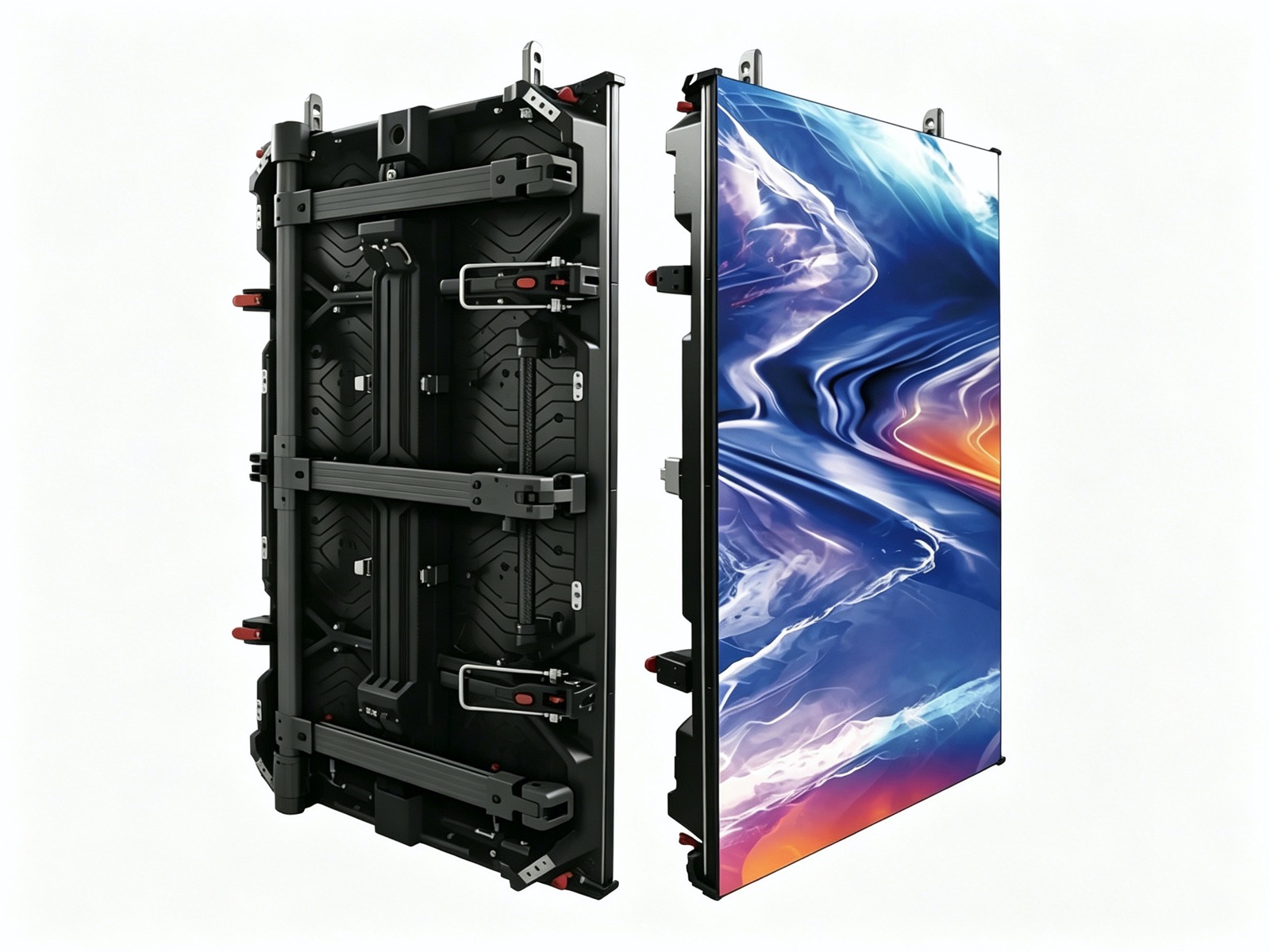
| Asia Vision CV-PRO COB P2.6 | Indoor COB panel at 600 x 337.5 mm with high refresh and a deep black level. The standard choice for scenic backdrops and touring sets. |
| Asia Vision COB Dance Floor P1.98 | 500 x 500 mm floor panel rated for 2000 kg/sqm with IP65 sealing and an anti-slip surface. Built for performers working directly on the display. |
| Asia Vision I-BOARD P1.95 | Ultra-thin indoor panel, 750 x 250 mm and 750 x 500 mm, 34.5 mm profile, magnetic front service. Used for lobby, box office and foyer signage. |
| Asia Vision CV-PRO P3.9 | Larger-pitch panel for cyclorama and wide rear-stage coverage where the audience viewing distance allows a coarser specification. |
A theater installation lives or dies on reliability during a run, because a failure mid-performance is visible to the whole audience in a way that a fault in a retail display never is. Asia Vision Technology builds panels with industrial power supplies and consistent calibration so a wall behaves predictably across a long run and across a tour that moves between venues. Refresh rates run at 3840 Hz or above, which keeps the display clean for venues that film or stream their productions, and the range is available with passive or near-silent cooling for rooms where a fan would be heard.
The COB products in the range are particularly suited to performance work because the sealed face protects the emitter array during the handling, loading and striking that touring involves. Pixel pitch spans P0.9 to P20 so a fine lobby panel and a wide cyclorama can both come from the same supplier, and indoor brightness runs from 800 to 2500 nits with dimming that lets a stage panel be brought down to a level a lighting designer is happy with.
Certification covers CE, FCC and RoHS, with UL and ETL available for North American venues and UKCA for the UK. Emitter life is rated at 100,000 hours so a permanent installation does not need panel replacement partway through its working life, and the standard warranty is three years. Delivery is quoted at 15 to 20 working days, and factory-direct supply means a venue or a production company buys the specification the show needs rather than the configuration sitting in a local warehouse.
For this requirement our range covers it directly: the RH-PRO fine-pitch COB (flagship, full redundancy) and the COB CV-PRO series (Ultra-HD fine pitch).
Ready to upgrade with LED displays?
Contact Asia Vision for specs, pricing, and free consultation.
📩 Get a Quote WhatsApp