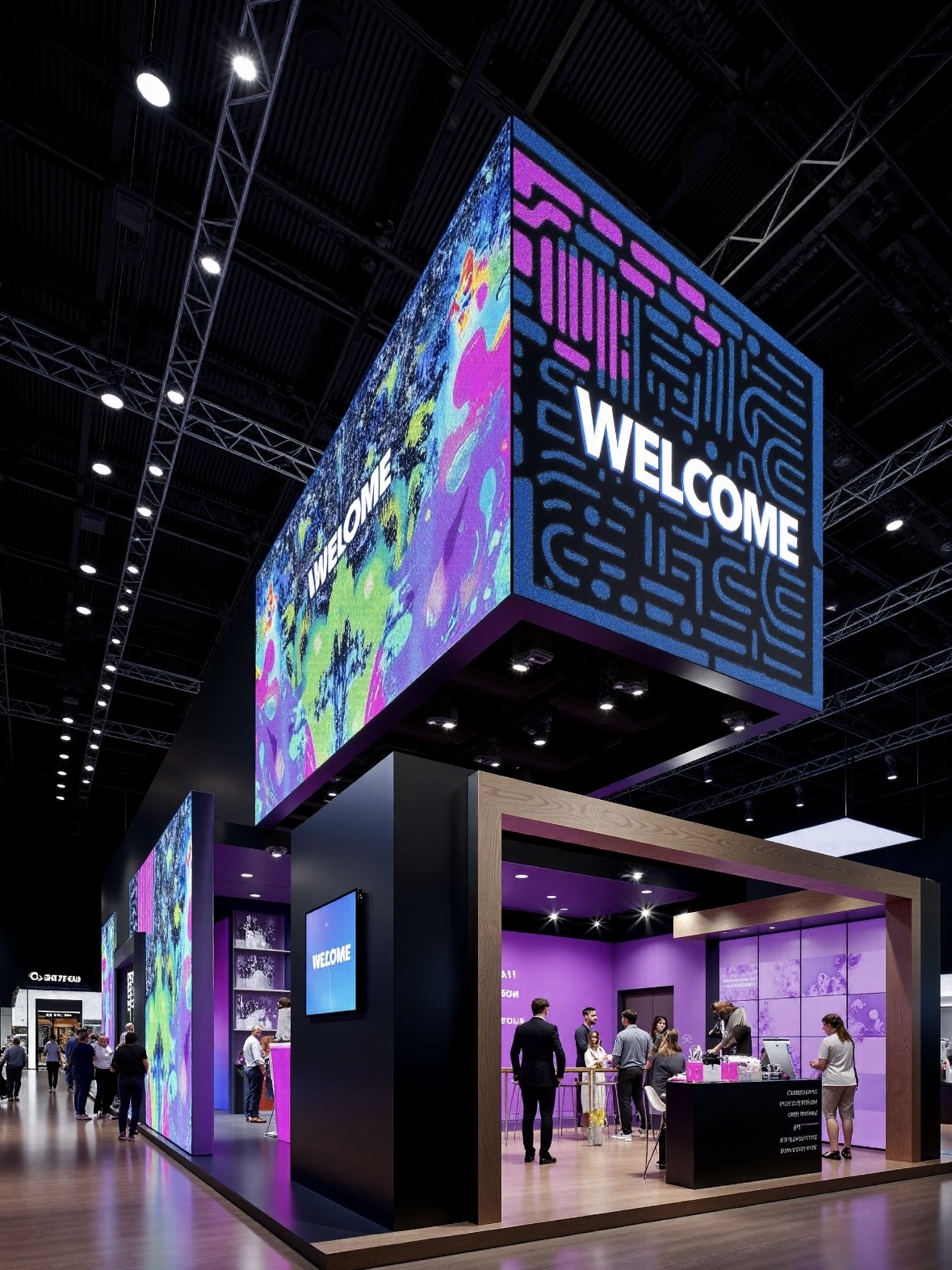
Holographic display has become one of the most overused terms in digital signage. True holography creates a real three-dimensional image; what most projects actually need is a transparent LED panel or a rotating LED fan that makes an image appear to float in mid-air. This guide separates the categories and explains where each one earns its place.
The demand is psychological before it is technical. A flat screen becomes invisible in a busy environment after the first few seconds, but an image that appears to hang in space interrupts the visual pattern and pulls the eye. Brands want that interruption at entrances, on end-caps and in windows, because the whole purpose of the placement is to stop a passer-by rather than to inform someone already watching.
Two product families meet the demand. Transparent LED displays use a sparse grid of LEDs on a see-through substrate, so a shopper can see the product behind the screen while graphics float on top of it. Rotating LED fans spin a blade of LEDs fast enough to paint a full image in the air, producing genuine view-from-anywhere 3D for a single viewer at a time. Both are branded as holographic, but they solve different problems and belong in different locations.
Retail and exhibition venues are the main buyers. A window with a transparent screen keeps the merchandise visible while adding motion, which matters on a street where the window is the first and sometimes only advertisement. A fan unit placed at eye height in a mall atrium creates a focal point that photographs well and spreads on social media, which is often the real return the client is buying.
Content design has become the practical bottleneck. A floating effect needs artwork built as short, looping clips with dark backgrounds, because a transparent panel can only draw attention where it is lit and a fan can only display bright pixels. Projects that expect to reuse an existing flat campaign usually fail, and projects that commission content for the format deliver the effect they were promised.
The economics favour these formats more than the headline cost suggests. A transparent panel or a fan unit occupies very little floor space, needs no dark room and draws far less power than a large illuminated light box with the same visual impact. For a retailer paying rent by the square metre, a display that adds motion without adding footprint is a better return than a bigger flat screen, and for an event organiser a single fan can create a focal point that a wall screen at twice the price would struggle to match.
Attention measurement has strengthened the argument further. Retailers can now watch how long people stop in front of a window, and a moving or apparently floating image reliably holds a gaze longer than a static panel of the same size. Since the value of a window display is a function of dwell time rather than of impressions, that extra second or two of attention translates directly into the metric the marketing team reports, which is usually what unlocks the budget in the first place.
Choose the technology by the viewing situation. If the audience walks past, or stands in a group, or needs to see the product behind the image, a transparent LED panel is the right tool. If the audience stops in front of a single position and looks for a few seconds, a rotating LED fan delivers a stronger three-dimensional illusion at lower cost. Some venues use both, with a transparent screen in the window and a fan on the counter inside.
Specify for the environment as well as the effect. Windows are usually bright, so a transparent panel needs enough output to compete with daylight and enough transparency to keep the merchandise legible behind it. A fan needs headroom for its rotating blade, a stable mount and a guard if the public can reach it. In every case the content has to be authored for the format, with dark backgrounds for transparency and short loops for the fan.
Plan the sightlines before the panel is ordered. A transparent screen performs best when the audience is roughly in front of it and the merchandise behind it is lit well enough to read; if the window is dark behind the screen, the transparency advantage is wasted and the panel behaves like a dim conventional display. A fan, by contrast, needs a clear arc for its blade and an open cone in front of it. Measuring the space and the traffic direction during the survey is what prevents a striking product from ending up where nobody stands.
Weight and rigging also differ sharply between the two formats. A transparent panel is a flat cabinet and mounts much like a conventional screen, with the added consideration that the surface behind it has to stay visible and lit. A rotating fan is a moving machine with a motor, a bearing and a spinning blade, and it needs a mount that tolerates sustained rotation as well as a service route to that motor. Some venues hang fans from a ceiling grid, which means the structure above has to be checked before the unit is ordered rather than after it arrives on site.
Finally, agree on a realistic update plan for both formats. Transparent panels and fan displays tend to sit in high-traffic positions where the content is seen many times a day, and an image that never changes stops working within weeks. Budget for a content refresh schedule alongside the hardware, keep the source files so a designer can adapt them for the next campaign, and the installation will keep earning the attention it was bought to capture.
| Application | Series | Key Specs |
|---|---|---|
| Retail window transparent screen | Transparent LED P3.9 | High transparency, daylight output, slim frame |
| Mall atrium floating display | LED Fan P2.5 | Rotating blade, view-from-anywhere effect |
| Brand activation and booth | CV-PRO P1.8 | Fine pitch, 3840Hz, high contrast backing |
| Museum artifact overlay | Transparent LED P6 | Discreet grid, low glare, quiet operation |
| Event stage holographic look | X Series P3.9 | 500x500mm cabinet, 6.5kg, quick rig |
Holographic projects live or die on the fit between the hardware, the mounting and the content, so we prefer to design them as one package. Asia Vision Technology supplies transparent LED panels and rotating fan displays alongside the conventional CV-PRO and X families, all carrying CE, FCC and RoHS certification, so a venue can source a coherent look from one supplier instead of stitching together incompatible formats.
We also help with the part most suppliers ignore: content guidance. Because we know the transparency percentage of each panel and the rotation pattern of each fan, we can tell a designer how much of the background will show through and how bright the artwork needs to be before a single frame is produced. Products ship on a 15 to 20 working day cycle with a three-year warranty, and matched spare modules are held for each build.
We also help clients avoid over-buying. Holographic hardware attracts ambitious briefs, and it is easy to specify a fan where a transparent panel would serve better, or an expensive fine-pitch backing screen where a simple transparent grid would do the job. Because we supply the transparent, fan and conventional families from one factory, the recommendation follows the space and the content rather than a single product we are trying to move. That approach is what brings venues back for their next installation instead of sending them elsewhere for a second opinion.
For this requirement our range covers it directly: the X Series (front/rear service, common parts across platforms) and the series overview for spare-part lists.
Need LED display solutions?
Contact Asia Vision for competitive pricing and specs.
📩 Get a Quote WhatsApp