By David
A display installed in a hospital is not just a screen. It becomes part of the environment that has to be cleaned, and that changes how it should be specified and how it can be installed. In healthcare, infection prevention is not a final sign-off — it is an input to the specification and the schedule.
This guide explains what infection control asks of an LED display, and where those requirements land in a hospital project.
In a patient area, every surface is cleaned on a routine. Anything fixed to the wall or the ceiling joins that routine, and the questions infection prevention asks are practical ones.
Can the surface be wiped with the agents the hospital already uses, without the finish degrading? Does the enclosure present ledges, seams or openings where dust and soil collect and are hard to reach? Is there any path — a vent, a gap, an exposed fan — by which soil or moisture enters the housing? And can the panel be cleaned without removing it from the wall?
These are specification questions, and they are better answered before purchase than after installation.
The answers point towards a particular kind of product rather than a particular brand.
| Infection control concern | What the display should offer |
|---|---|
| Routine cleaning | A sealed, smooth front surface that tolerates the hospital's cleaning agents without clouding or lifting |
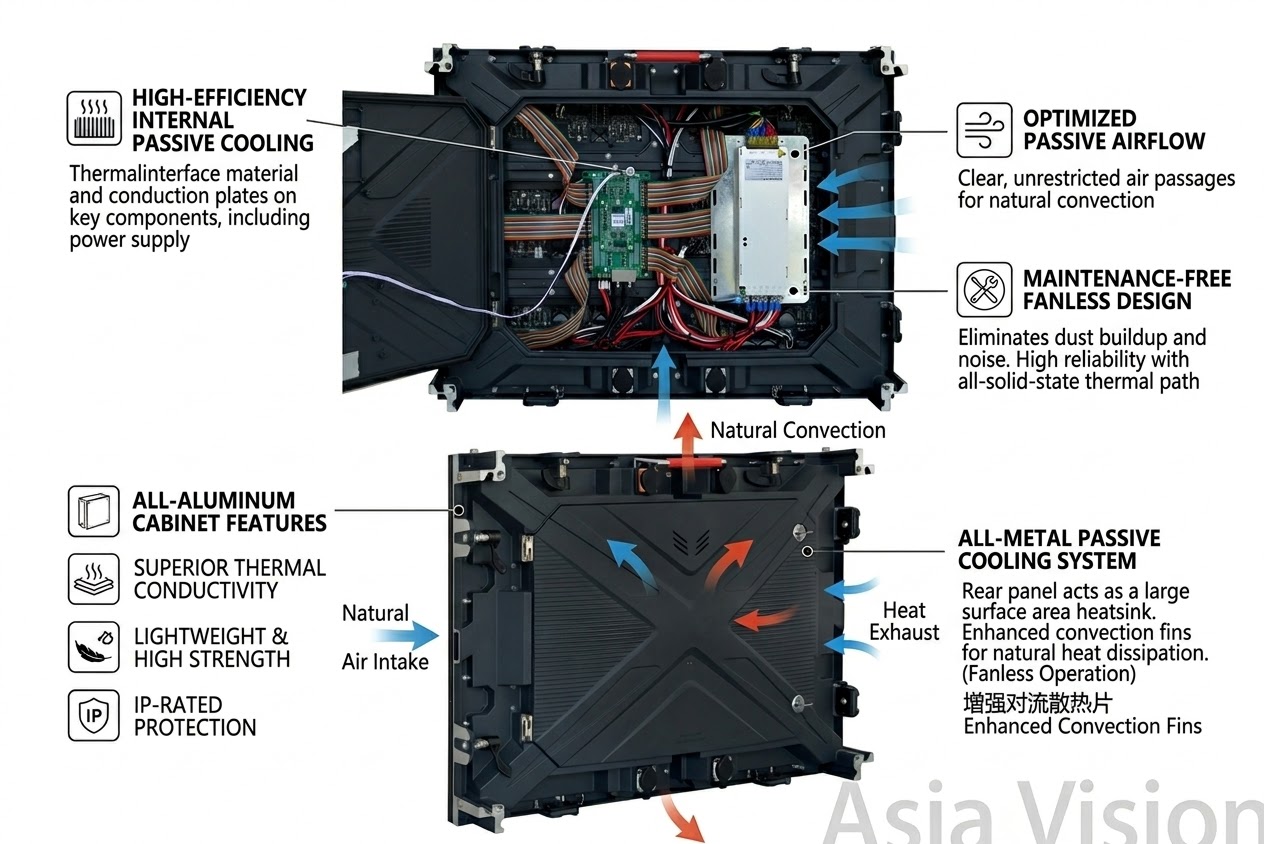
| Dust and soil collection | A closed cabinet without exposed vents, grilles or unfiltered cooling paths in the patient-facing area |
| Hard-to-reach seams | Minimal external joints; a front-face structure that can be wiped as one surface |
| Cleaning without dismantling | Front-access construction so the face can be cleaned and modules replaced without removing the wall |
A fine-pitch COB display fits this profile well, because the chip-on-board surface is bonded and sealed rather than left as exposed lamps, which makes it a continuous wipeable face rather than a field of small components.
Before installation work begins in or near a patient area, the hospital assesses the infection risk it creates. This is carried out by the hospital's infection prevention team under its own procedure, and it applies to installation and construction work — including the work of putting a screen on a wall.
The assessment decides how the work is done rather than whether it is allowed: dust barriers, working outside patient hours, phased installation, and routes for materials and waste. It is a hospital process, not a vendor's, and the installer follows it.
Hospitals rarely close in order to install a screen. Work happens around patients, which usually means some combination of the following, decided case by case.
Working in a defined area separated from patients, and doing the noisier or dustier parts of the job outside clinical hours. Bringing the wall in during a quieter period and completing it in stages. And sequencing the work so that power and data are terminated without taking clinical systems down.
The practical consequence is that a hospital installation should be planned by someone who has worked in an occupied healthcare building, and priced accordingly rather than as a plain interior fit.
The single most useful document a manufacturer can provide for a healthcare project is the surface and cleaning information for the specified panel.
Given to infection prevention, it allows the team to confirm compatibility with the agents in use before the purchase is made, rather than after the screen is on the wall and a cleaning product has clouded the surface. It also gives facilities the care instructions they will keep for the life of the installation.
The manufacturer's contribution is to make the clinical answer available early, so it does not become a late objection.
Our factory runs 8 IC production lines and 7 LED SMT production lines under ISO 9001:2015, with CE, FCC and RoHS certification, a 15 to 20 working day lead time and a three-year warranty. We supply performance cut sheets, dimensioned drawings and surface information for submittals, and front-access cabinet options so a panel can be serviced without disturbing the surrounding finish. For a sealed, wipeable face in a clinical environment the usual match is the COB CV-PRO fine-pitch series.
For the buying process around the screen, see how hospitals buy LED displays and the healthcare LED display guide.
Send your specifications for a detailed LED display price quote with UL/ETL certification.
Request Price Quote Chat on WhatsApp