By David
What is LED display viewing angle? LED display viewing angle is the range of positions from which a screen can be seen with acceptable brightness and color. It is measured as the angle at which brightness falls to half its straight-on value. This 2026 guide explains how horizontal and vertical viewing angle affect mounting choices and why the number in the brochure is not the number you should design to.
Viewing angle is one of the most overlooked specifications in LED buying, and one of the most visible when it is wrong. A wall that looks bright from the center of a room can look dim and washed out from the seats at the side. On a stage, the difference between the front row and the far side can change how the whole production reads.
Buyers who plan the seating layout and the mounting height before choosing cabinets avoid the problem. Buyers who choose cabinets first and plan the room second often discover that half the audience gets a second-rate image.
Every LED screen has two viewing angle figures. The horizontal figure describes how far to the left and right the image stays acceptable. The vertical figure describes how far above and below. Both are usually quoted as the angle at which brightness drops to 50 percent of the on-axis value.
A screen quoted at 160 degrees horizontal and 140 degrees vertical keeps a usable image across a wide sweep and a moderate vertical range. Narrow-angle screens might reach only 120 degrees horizontal, which is fine for a straight-on audience and poor for wide rooms.
| Viewing Angle (H) | Design Meaning | Typical Application |
|---|---|---|
| 100-120 deg | Narrow; best straight-on | Narrow corridors, single viewpoint |
| 140 deg | Moderate coverage | Standard indoor signage |
| 160 deg | Wide coverage | Retail, worship, general AV |
| 170+ deg | Very wide; near side-on | Stadium, arena, public concourse |
The published viewing angle is measured in ideal conditions. It usually describes the angle at which brightness falls to 50 percent, not the angle at which the image still looks good. In practice, color shift and contrast loss appear before the brightness threshold, so the usable angle is smaller than the quoted figure.
For critical projects, ask for a brightness-versus-angle curve, not a single number. The curve shows how quickly the image degrades as the viewer moves off-axis, which is the information you actually need to plan a layout.
As a viewer moves to the side, brightness falls and the image dims. The rate of falloff depends on the LED lamp design and the lens or mask on the module. Screens with deep masks and quality lamps hold brightness better at an angle than screens with shallow masks and cheap lamps.
Color also shifts off-axis. Some screens turn bluish or greenish at wide angles, which is more noticeable in content with white backgrounds and brand colors. Buyers should test a white and a brand-color image at the planned maximum angle before accepting a specification.
Vertical viewing angle matters whenever the screen sits above or below eye level. A screen mounted high on a wall is viewed from below, and a screen mounted low is viewed from above. Both stretch the vertical angle requirement and can push the image outside the good viewing range.
| Mounting Position | Vertical Angle Demand | Buyer Action |
|---|---|---|
| Eye level | Low; center of range | Standard cabinets are fine |
| High on wall | High; viewers look up | Check vertical angle, avoid extreme tilt |
| Low near floor | High; viewers look down | Confirm vertical spec, consider tilt |
| Above stage | Mixed; close and far seats | Model the worst seat, not the best |
Model the worst seat in the room, not the best. The person in the front corner or the back balcony defines the angle the screen must serve. Designing to the center seat is the most common cause of disappointment after installation.
Pixel pitch and viewing angle work together. A fine pitch screen viewed from close up needs a wide angle so nearby side seats still get a clean image. A coarse pitch screen viewed from far away tolerates a narrower angle because the viewer is more distant and more centered.
Match the two specifications to the room. A very fine pitch screen with a narrow angle can look worse from the side than a coarser screen with a wide angle, because the fine detail is lost entirely outside the angle. Balance pitch against angle rather than maximizing one.
Cabinet choices affect angle performance. Modules with deep masks separate the LEDs and hold brightness at an angle, while flat, open-face modules dim faster. Curved and flexible modules can follow a viewing arc, which helps when the audience wraps around the screen.
Write the viewing angle requirement as the angle the screen must serve at the worst seat, with a minimum brightness retention figure. For example: "At the maximum horizontal angle to the worst seat, brightness must remain above 70 percent of on-axis and color shift must stay within a defined tolerance."
Add the acceptance test to the commissioning plan. When the screen is installed, photograph white and brand-color content from the worst seat and compare it to the agreed standard. This turns viewing angle from a brochure claim into a measurable part of the project.
Rental screens face the widest range of audience positions because the same panel is used in a different venue every week. A rental company should choose wide-angle cabinets so that side-stage seats and balcony rows still see a bright image. Narrow-angle panels that look fine in one arena become a liability in the next.
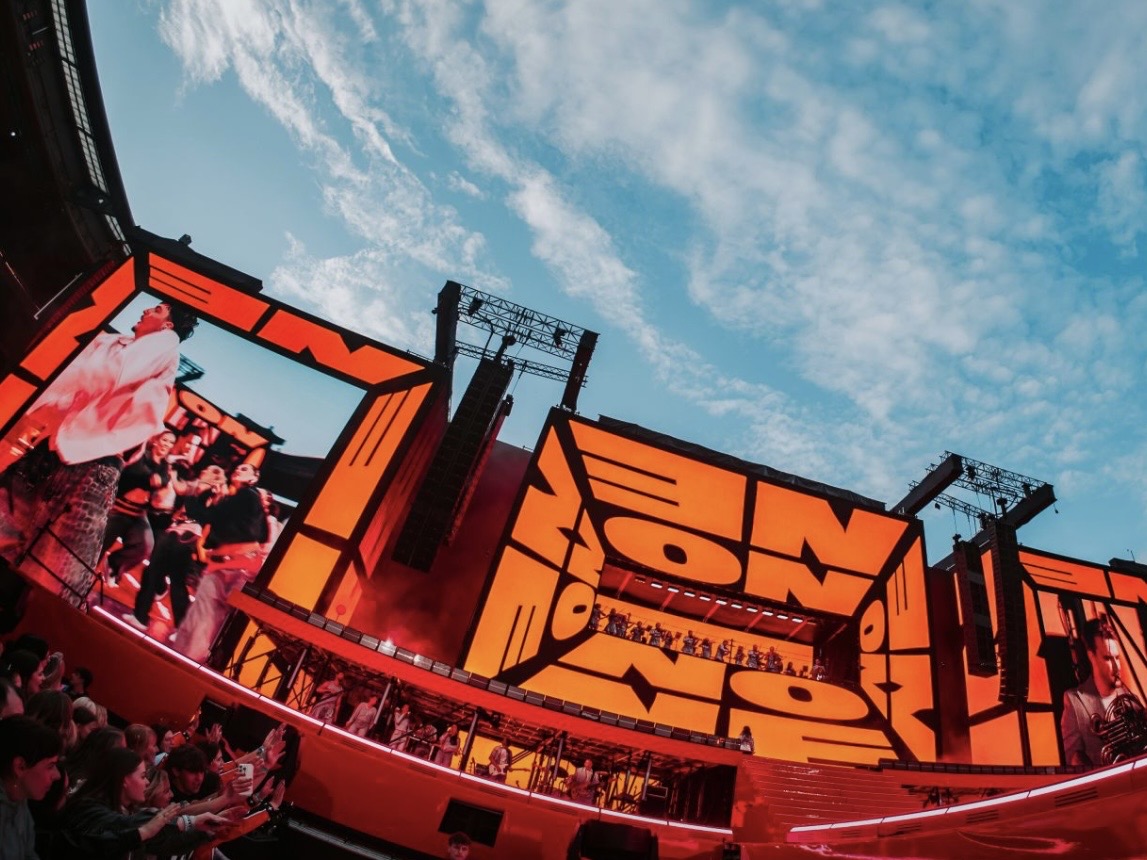
For events with side screens or thrust stages, the audience may wrap around the display. In these layouts the horizontal angle can exceed 140 degrees, which rules out many standard cabinets. Check the worst venue in the tour schedule, not the average one, before standardizing on a cabinet.
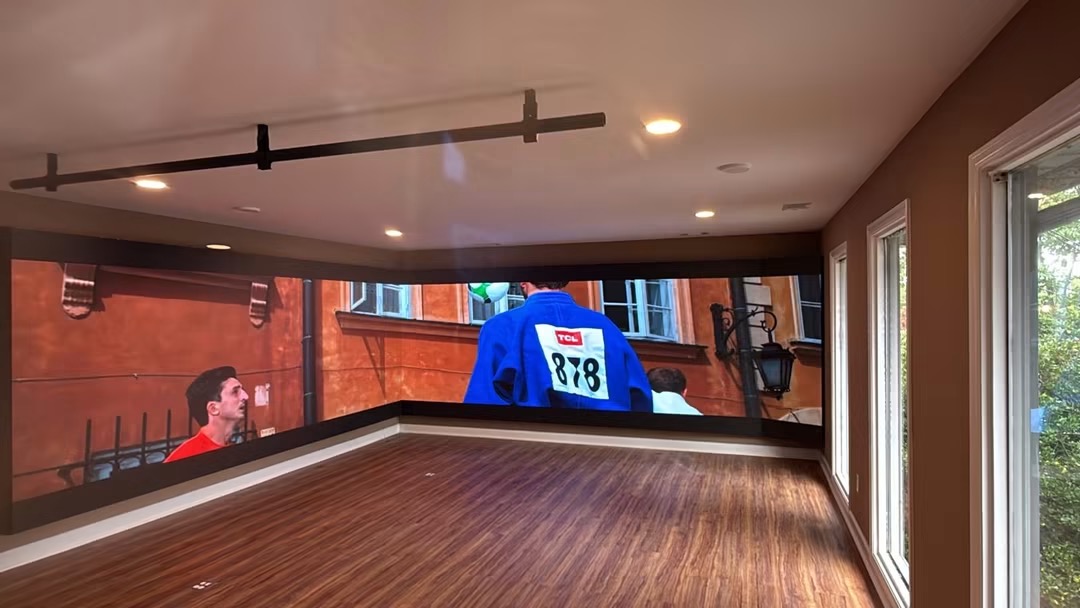
Curved and flexible modules let a screen follow the seating arc, which keeps viewers closer to on-axis across the whole wall. For a wide room, a gently curved wall can hold a better angle for the side seats than a flat wall of the same width. The trade-off is higher cost and more complex installation.
A curved wall is not automatically better. In a narrow room facing straight ahead, a flat wall is simpler and costs less for the same result. The curve pays off only when the audience genuinely wraps around the screen and the side seats matter.
The final check happens after installation. Walk to the worst seat, display a white screen and a brand-color screen, and compare what you see with the agreed standard. Photograph each position with the same camera settings so the results are comparable and can be recorded in the handover file.
If a cabinet underperforms at the angle you specified, raise it during commissioning, not after the room is in service. The acceptance test is the moment when a viewing angle claim becomes a fact, and it is the buyer's best protection against a screen that only works from the center seat.
Viewing angle decides whether every seat in the room sees the screen the way you intended. Plan it from the seating layout outward, test the worst position, and specify it in measurable terms so the result matches the plan.
Send us your seating plan and mounting height, and we will recommend cabinets that serve every seat.
Request Viewing Angle SpecChat on WhatsApp