By David
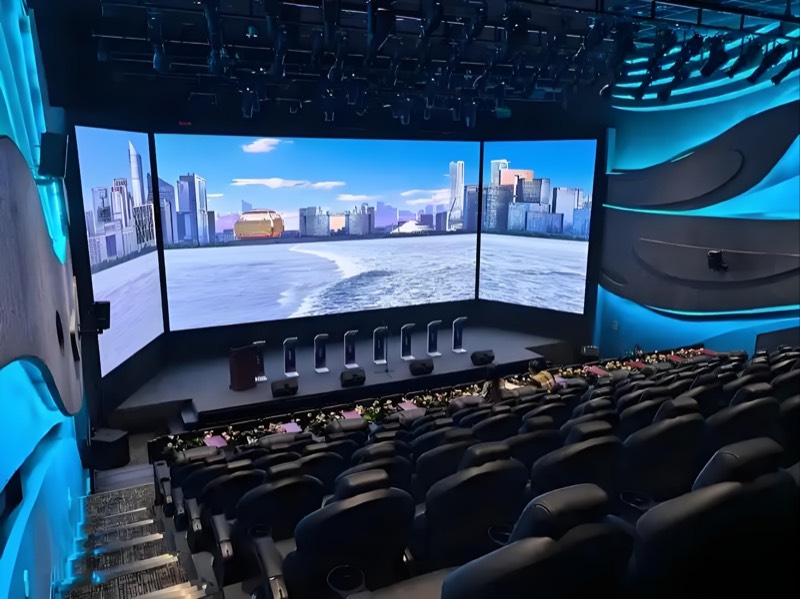
What does it take to build an LED backdrop for a global product launch? This project put an 80 square metre curved LED wall behind the stage at a Shenzhen technology launch — P2.6 rental panels, 7680Hz refresh for the live stream, and wings that curved forward on each side. It had to look cinematic to 300 people in the room and simultaneously survive broadcast cameras sending the feed to hundreds of thousands online.
That double requirement — a stage that works for the audience and for the lens — is what separates a launch backdrop from an ordinary event screen. Here is how the specification was put together and what a buyer planning a similar build should know.
A product launch has an unusual constraint. The people in the room see the wall with their own eyes, but the far larger audience sees it only through a camera. A wall that looks perfect in person can read as flickering bars on the live stream, and a wall tuned only for camera can look washed out on stage.
Three requirements came out of that brief:
Pixel pitch is chosen by the closest viewer, and on a launch stage the closest viewer is a camera.
At roughly 80 square metres, the wall is large enough that the audience sits well back, but a broadcast camera can push in far closer than any person in the room. The question is not "how far is the back row" but "how tight will the tightest shot be."
| Pitch | Comfortable minimum viewing | Effect on an 80㎡ stage |
|---|---|---|
| P3.91 | ~6 m+ | Visible pixel structure on camera close-ups |
| P2.6 | ~5 m | Clean at stage distance and in medium camera shots |
| P1.95 | ~3.5 m | Cleaner on tight close-ups, higher cost per m² |
| P1.5 and finer | ~2.5 m | Rarely justified for a stage of this size |
P2.6 was the balance point: dense enough that the pixels disappear at stage distance and in medium shots, without paying for fine pitch across 80 square metres of wall that no one views from a metre away. The panels used here are from the COB Z rental series, which covers P1.95 and P2.6 in the same cabinet family — so a project can step up to the finer pitch in one section without changing rigging or spares.
This is the specification most launch projects get wrong, because it does not affect how the wall looks to the eye at all.
A camera does not capture a moment — it captures a slice of time set by its shutter. If the LED panel refreshes more slowly than the camera samples, the camera catches the panel mid-cycle, and you see the result as horizontal scan lines, rolling bands, or a shimmering moire pattern. The audience in the room sees none of it; the stream sees all of it.
The COB Z panels used on this stage run at 7680Hz. In practice that means the camera can be pushed in on the performer against the backdrop, or pan across the wall during a walk-on, without the wall betraying that it is a screen at all. For a launch event where the backdrop is the visual identity of the announcement, that is not a luxury specification — it is the whole point.
If your project involves cameras, broadcast, or XR, the same logic applies. Our high refresh rate buying guide walks through how to match refresh to the cameras actually in the room.
The design called for the wall to break forward at both ends, wrapping the stage rather than sitting behind it as a rectangle.
This is routine for rental cabinets and awkward for fixed ones. Rental panels lock edge to edge with adjustable angle joiners, so a run of flat wall can transition into a curve at any cabinet seam. The practical limit is the cabinet width: at 500mm per cabinet, an arc stays visually smooth down to a fairly tight radius before the seam gap starts to show, and the content team can mask the remaining gap in the artwork.
The same cabinets that make the curve possible also make the schedule possible. Rental frames arrive pre-rigged, hang from a single flown truss line, and are levelled cabinet by cabinet — which is why a wall of this size can be up in a day rather than a week.
| Parameter | Specification | Why it mattered here |
|---|---|---|
| Pixel pitch | P2.6 | Clean at ~5m stage distance and in camera medium shots |
| Total area | 80㎡ | Filled the stage without overwhelming the presenter |
| Refresh rate | 7680Hz | Artifact-free on the live broadcast feed |
| Shape | Flat centre + curved wings | Wrapped the stage; impossible to fake with a flat wall |
| Cabinet type | Rental, 500×500mm | Angle-adjustable joins for the curve, fast flown rigging |
| Service | Front and rear access | Any panel reachable during rehearsal without striking the wall |
On a launch there is no second take. If a panel goes down during rehearsal — a connector, a receiving card, a power supply — the crew has to reach it without dismantling the wall or losing the day's camera session.
Front-and-rear serviceable cabinets mean any single panel can be swapped from the front while the wall stays flown. On a fixed installation this is convenience; on a launch with a locked rehearsal schedule it is the difference between a fix and a crisis.
Large event walls are won or lost in the schedule, not the hardware. The sequence that keeps a launch on track:
The last step is the one that catches problems. A wall can pass every bench test and still interact badly with a specific camera at a specific shutter angle. Testing with the real broadcast kit on site, before the event, is what turns a 7680Hz specification into a clean feed.
The wall ran as an 80 square metre curved backdrop behind the launch stage, carrying the event's visual identity to 300+ people in the room and to the live stream audience of hundreds of thousands — with no refresh artifacts reported in the broadcast feed.
For the client, the outcome is not just "the screen worked." It is that the backdrop read as part of the show on camera: the presenter stood inside the visual, close-ups held up, and the wall never betrayed that it was an assembly of 500mm panels.
If your project is a launch, a keynote, or any stage where the screen is filmed, the specification conversation starts with the camera. See the COB Z rental series for the pitch and refresh options, or the E-PRO series if the project also involves XR or virtual production volumes.
Tell us the stage size, the closest camera distance, and whether it will be filmed — we will confirm the pitch and refresh that fit, and quote it.
Request a QuoteChat on WhatsApp