By David
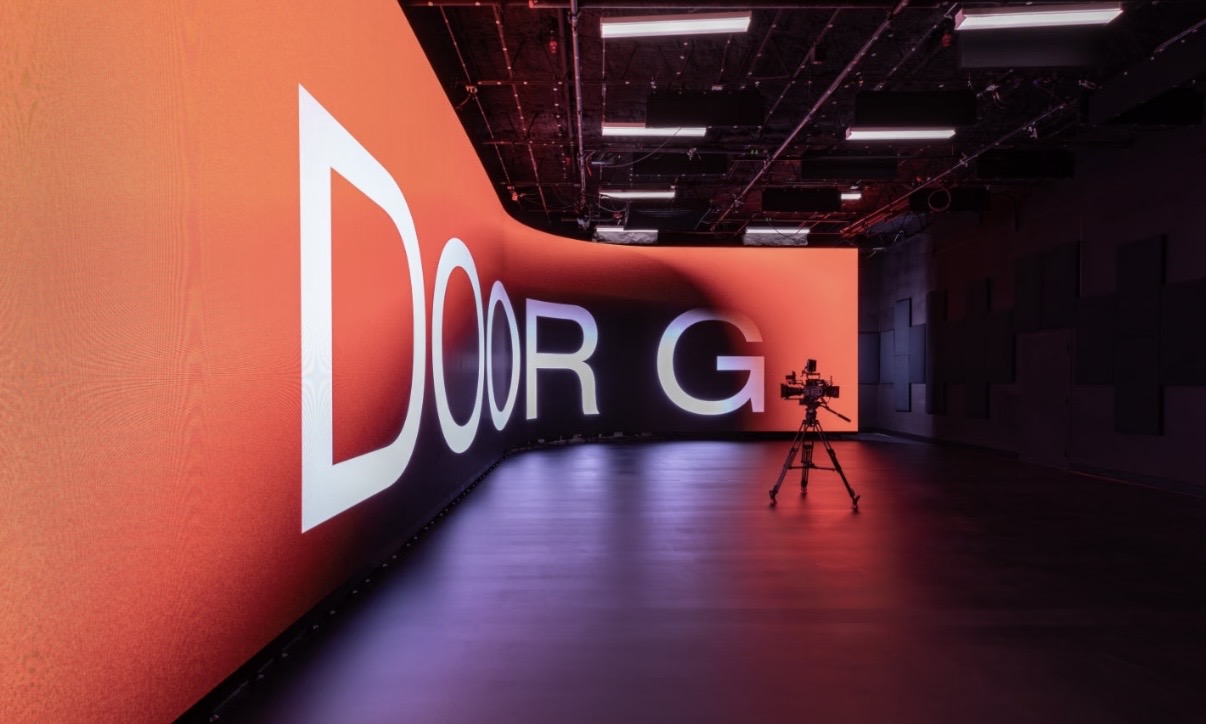
What does it take to build an XR volume that a production can actually shoot in? This stage was built around a 17m × 4m J-shaped LED wall — rigid and flexible P1.95 panels spliced into one continuous curved surface, with an integrated LED ceiling above. The wall runs Unreal Engine content for in-camera VFX, graded for HDR, and locked to the camera so every frame stays clean.
An LED volume is not a large screen. It is a camera environment, and almost every specification decision is made from the camera's point of view rather than the audience's. This case study walks through what those decisions were and why they mattered.
In traditional production, actors perform in front of a green screen and the world is added later. In an LED volume, the world is already there when the camera rolls.
Virtual environment content is displayed on the LED walls in real time, driven by the game engine, and the camera films the actor and the background together. Because the camera can see the actual set, the lighting, reflections and parallax are real rather than simulated. Visual effects work moves from post-production into the shoot.
That shift changes what the LED wall has to do. It is no longer a background to look at — it is part of the optical path of the camera.
A flat LED wall works until the camera turns. As soon as the shot moves off-axis, the edge of the screen enters frame and the illusion ends — the audience sees the boundary between virtual and physical.
A J-shape solves that by wrapping the LED surface around the performance area. The wall runs straight along the main view, then curves in at the end, so the camera can pan or move laterally and still see continuous environment instead of an edge. The curve also improves parallax: as the camera moves, the virtual background shifts the way a real three-dimensional scene would, because the screen is genuinely surrounding the subject.
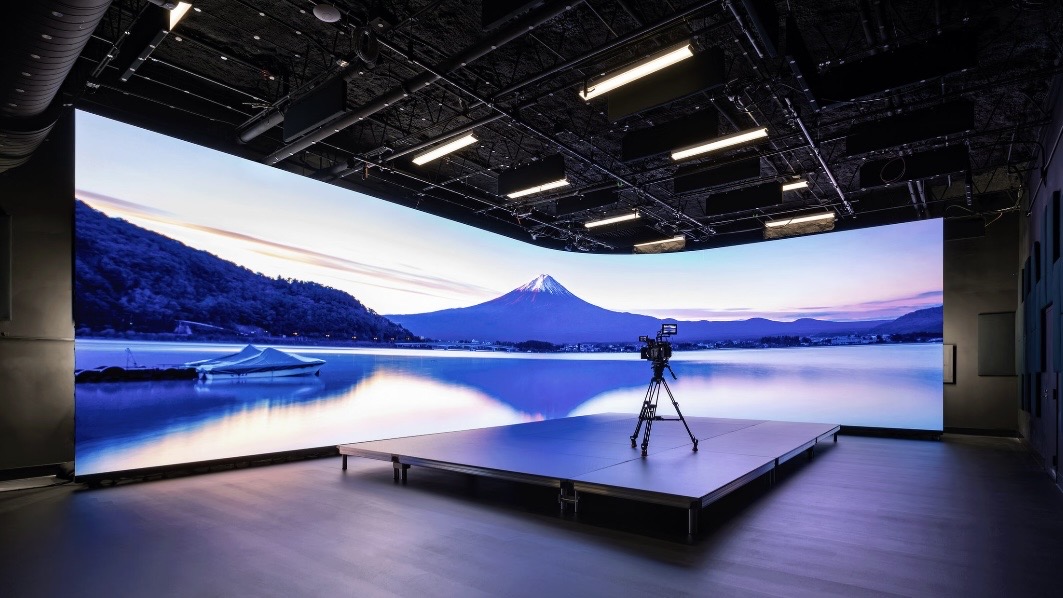
This is the detail that defines the build. The wall is not one type of panel throughout — it combines rigid and flexible P1.95 panels into a single continuous surface.
| Panel type | Where it is used | Why |
|---|---|---|
| Rigid P1.95 | Main flat run of the wall | Maximum stability and flatness across large areas; predictable seams |
| Flexible P1.95 | The J-curve and the transition to the ceiling | Can be bent to a tight radius without breaking the surface |
Using flexible panels only where the geometry demands it — and rigid panels everywhere else — means the flat sections stay as flat as possible while the curve stays smooth. The critical requirement is that both types read as one surface at P1.95: same pitch, same brightness, same colour response, no visible transition where the panel type changes.
In an LED volume, the camera and the wall have to be frame-locked. The panel must refresh in step with the camera's shutter, so that each frame is captured with the screen in a complete, stable state.
Without synchronisation the camera catches the panel mid-refresh and the footage shows banding, tearing or a rolling artefact that no amount of grading fixes. This is why volume stages invest in genlock and sync hardware rather than treating the LED wall as a display device.
The practical consequence for the screen itself is that refresh rate is not a marketing number here — it is the parameter that determines whether the stage can be used at all. A volume wall has to hold sync across shutter angles the production actually shoots at.
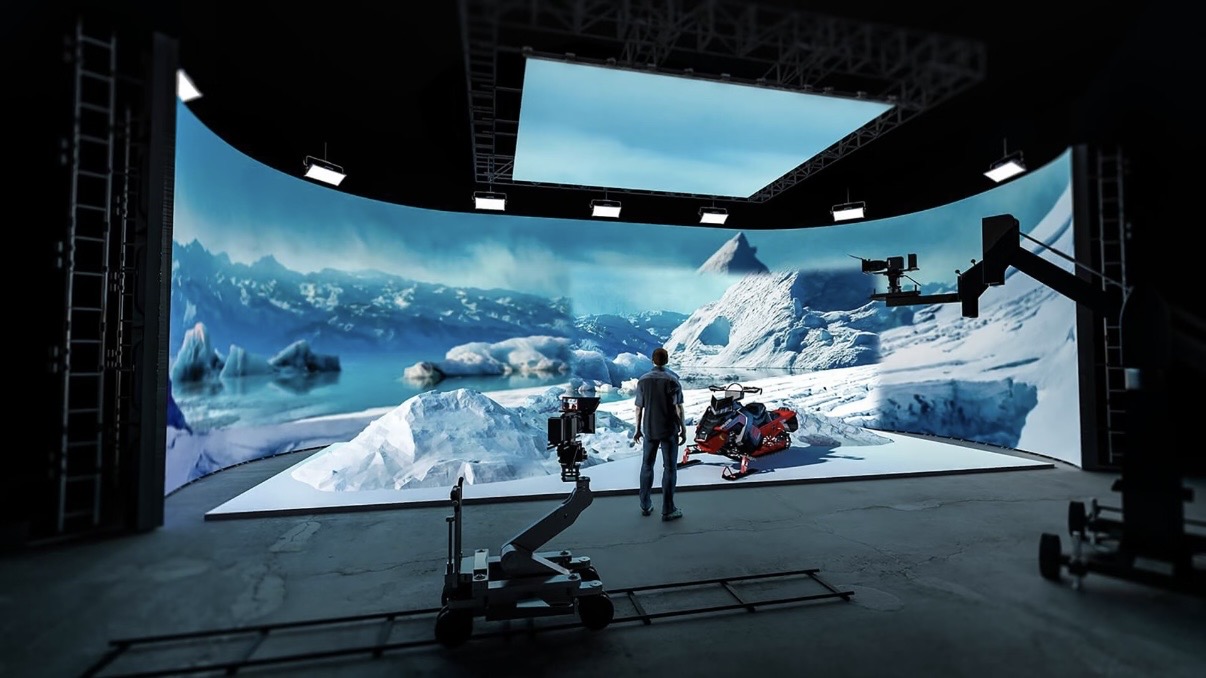
Content on an LED volume is rendered live, which means the wall has to be accurate enough that what the engine outputs is what the camera captures. Two pipeline details matter:
HDR grading matters here for the same reason. Volume work often runs dark — night exteriors, moody interiors, scenes with strong highlights against deep shadow. The wall must preserve detail in both, because the camera captures whatever the wall emits and there is no post-production stage to recover information that was never displayed.
An LED volume running a dark scene is the most demanding condition a display can be asked to meet, and it is invisible in a product demonstration.
In a bright, colourful demo the eye is forgiving. In a dark volume, three problems appear at once:
This is why volume work is specified for dark-scene optimisation rather than peak brightness. The wall has to be as good at near-black as it is at full output.
This stage includes an integrated LED ceiling, not only walls. That is not a decorative addition.
When a virtual environment has a sky, a ceiling, or any overhead element, the camera will eventually look up — or catch it in a reflection, a helmet visor, a car windscreen or a glossy surface. Without an LED ceiling, everything above the horizon has to be added in post, and the actor is lit by a black void rather than by the environment they are supposed to be standing in.
Adding the ceiling extends the illusion upward and gives the lighting department a real source to work with. It also means the wall, ceiling and floor have to be colour-matched as one continuous environment.
The final result of these decisions is a stage that reads far larger than 17 metres by 4 metres.
Because the join between the physical set and the digital environment is seamless — same pitch, same colour, same brightness across the transition — the camera can push toward the boundary without the audience noticing where the real set ends. The production gets the usable depth of a much larger stage, while the physical footprint stays the size of the room it occupies.
That is the actual return on a volume build: not the size of the wall, but the number of shots that can be captured inside the room without leaving it.
The stage runs as a 17m × 4m J-shaped LED volume with an integrated ceiling, rigid and flexible P1.95 panels forming one continuous curved surface, camera-locked for Unreal Engine in-camera VFX and graded for HDR with dark-scene optimisation — allowing the physical set and the digital environment to join without a visible seam.
For volume work, the starting point is usually a fine-pitch panel platform that can be supplied in both rigid and flexible form and colour-matched as one batch — see the RH-PRO COB series for fine pitch, or the E-PRO series where the stage also serves rental and XR work.
Tell us the camera setup, the stage geometry and whether the environment includes a ceiling — we will confirm the panel mix, pitch and sync approach that fits.
Request a QuoteChat on WhatsApp